
Field Notes · The Life Mirror · The Walk
Your Autopilot Is
Running the Round
The course doesn’t create your leadership pattern. It gives you no place left to hide from it.

“Your autopilot runs your game. Most of what happens in a round happens below conscious thought. Pressure exposes the pattern already running.”
The Man Who Arrived Before You Did
Watch a man settle into the rhythm of a round somewhere around the fourth hole.
The first tee nerves have burned off. His scorecard is already complicated — a double on two, a clean par on three that he immediately second-guessed. He’s talking, but his eyes are somewhere else. He picks up his pace between shots. His pre-shot routine — if he has one — is compressing. He is three holes in and already calculating damage, already narrating, already managing the gap between what he expected and what is happening.
He has never stopped working. He changed zip codes but not operating modes.
This is the executive whose internal engine never idles. He does not take rounds off any more than he takes days off. The course becomes another performance theater — a new stage for the same production. He arrives with his strategy already written, his outcome already weighted, his identity already on the line. The ball hasn’t moved yet and the pressure is already redlining.
Here is what the course knows that he doesn’t: the pattern running his round is the same pattern running his organization.
This is the diagnostic power of The Course is the Mirror — Using Golf as a Diagnostic Tool for Leadership. The course doesn’t generate your behavioral pattern. It simply gives it nowhere left to hide. Eighteen holes of real shots, real pressure, real feedback, no filter. The ball reports what the body is actually doing, not what the mind has decided to believe about itself.
A golf ball tells the truth. It shows what happens when what you want meets stress, when trust holds, and when it slips.
The Obstacle Was Never Your Swing
There is a persistent and expensive myth in golf instruction: that the problem is mechanical.
So the executive books the lesson. He watches the video. He hears the language of attack angles and shaft lean and hip rotation sequencing. He practices on the range, where the variables are controlled and the only thing at stake is the next ball in the bucket. And the pattern improves. He leaves feeling capable.
Then he plays a round with his largest client. Or the day after a board meeting that didn’t resolve the way he needed. Or the morning his phone showed seventeen unread messages before he got out of bed. And the pattern that left on the range returns on the course, quietly and completely, as if the lesson never happened.
Because the obstacle was never the swing. The real handicap is the story running beneath the swing.
“The real handicap is the story you tell yourself under pressure. Fix the story, and the swing follows.”
Most of what happens in a round happens below conscious thought. The body has a pattern — a deeply grooved autopilot — that was written long before this round, long before this club, possibly long before this career. Under stress, the body defaults to that pattern with remarkable precision and zero apology. The survival brain takes over. The prefrontal cortex — responsible for fine motor sequencing, spatial awareness, and measured decision-making — steps back. What’s left is the unedited version of the player.
And here is where the diagnostic gets expensive for leaders: the boardroom version of this same phenomenon is playing out every week, mostly unobserved. The leader who rushes decisions under pressure, who tightens control when the stakes rise, who accelerates into complexity rather than pausing to regulate — he is running the same autopilot the course just exposed. He is just doing it in rooms where no one has the language to name what they’re seeing.
The course has the language. It speaks in ball flight.
Reading the Round as a Leadership Audit
The course is not subtle. If you know what to look for, every hole is a data point. Below is a read of the most common patterns — what they look like on the turf, and what they’re quietly confessing about the leader behind them.
| On-Course Pattern | What It Confesses | Leadership Mirror |
|---|---|---|
| White-knuckle grip pressure | Confusion between control and safety | Micromanagement; decisions that bottleneck at one person; a team that waits |
| Rushed backswing and transition | Reactive operating mode; day starts before state stabilizes | Decisions made before Strategic Clarity is established; chronic catch-up mode |
| Over-swinging for distance | Output as identity; worth measured by size of result | Addition of force rather than removal of friction; burnout without name |
| Collapsing after a bogey | Thin emotional buffer under setback; identity attached to score | Leaders who lose access to Strategic Clarity after a missed quarter or a public failure |
| Accelerating pace of play under pressure | Speed as a coping mechanism; stillness feels like exposure | Leaders who fill space with activity to avoid the question the silence would ask |
| Ignoring the pre-shot routine | Bypassing the mechanism that creates Internal Quiet | Leaders who skip the preparation that creates state regulation, then wonder why execution degrades |
This is not psychology. This is performance data. The course is a clean, real-time instrument. It is the only assessment tool that doesn’t give you time to prepare your answers.
Carrying Less Is Not a Mindset. It Is a Mechanism.
There is a moment in most rounds when a man stops keeping score.
Not because he gives up. Because something releases. He stops calculating the gap between expectation and reality, stops running the internal negotiation between who he wants to be on the course and who the course keeps insisting he actually is. He picks a target, trusts the preparation, and makes the swing. And in that state of released expectation — more often than not — the ball goes somewhere honest.
This is what we call Carrying Less. And it is not a mindset hack.
The Bouncy System — the chain of sequenced movement that produces a fluid, powerful golf swing — does not function under compressive load. Tight hands kill feel. A braced midsection disrupts rotation. A locked jaw kills timing. The physics of the tool demand that the system stay supple, dynamic, and uncompressed. You cannot force your way to a free swing. The attempt to control it is exactly what collapses it.
The same physics operate in leadership. The leader who grips every decision, who carries every outcome as a measure of his personal adequacy, who braces against uncertainty by adding more process, more meetings, more oversight — he is compressing a system designed for fluid motion. Carrying Less is the Wu-wei of executive performance. The removal of friction rather than the addition of force.
What you put down on purpose turns into strength kept. The weight dropped is not accountability surrendered. It is false weight — the silent expectations, the performance armor, the story about what the result means about who you are. When that weight lifts, the authentic player has room to appear. Not the player performing the role. The player who actually knows how to play.
The same transfer is available in leadership. And the course is the most efficient classroom we have found to begin it.

What the Course Already Knows About You
The best caddies are not the ones who carry the most yardage in their head.
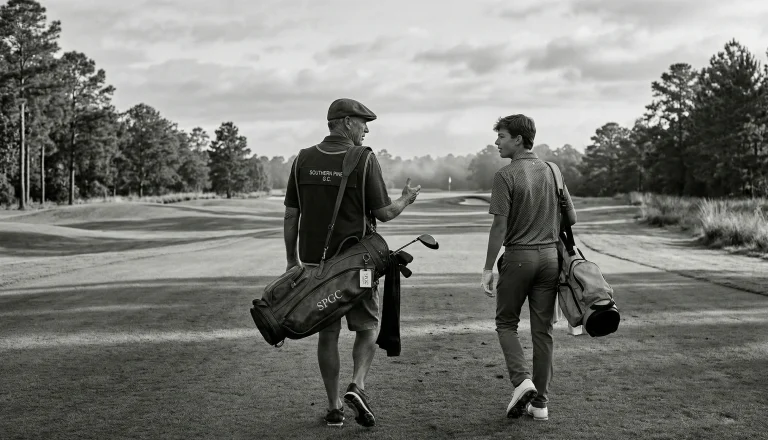
They are the ones who see your game more clearly than you do — not because they are better players, but because they are not trapped inside the story running your round. They stand slightly outside it. They watch the body, not the ball. They read the grip pressure before the swing happens. They notice when you stop breathing. They see the tell in your pace — the slight acceleration that signals the nervous system is heating up and the next decision is about to be made from the wrong state.
This is the caddie-to-player relationship at the core of The Caddie Within’s work. Not a cheerleader. Not a swing coach. A steady set of eyes, unclouded by the story you are carrying, reading the round with objectivity and directing attention where the actual leverage is.
On the course, that conversation is direct. We walk nine holes together. Real shots, real pressure, real feedback. You cannot perform for the diagnostic. The ball already filed its report before you finished your follow-through.
What becomes clear — consistently, across rounds, across players, across industries and titles and handicaps — is this: the obstacle is rarely what the player believes it is. It is almost always a layer below. A pattern in the body rather than an error in the mechanics. A story about the result rather than a problem with the motion. A bandwidth collapse rather than a skill deficit.
The course sees it. We name it. The player decides what to do with the data.
That is the work of The Course is the Mirror. Not borrowed identity. Not performance theater. Real shots, honest data, steady follow-through.
One Small, Honest Action
You do not fix autopilot by thinking harder. You do not regulate a redlining Internal Engine by adding more will to the problem. Both attempts produce the same result: more compression, more restriction, more distance from the fluid state the system is designed to find.
The entry point is smaller than most leaders expect. And the resistance is usually the size of the ego — the reluctance to acknowledge that the pattern running the round is not a golf problem.
Here is where to begin this week. Two tools. No equipment required.
-
The Drop Zone: Before You Step In
Before your next high-stakes conversation — not after, not during — pause for forty-five seconds. Inhale for four counts. Hold for seven. Exhale for eight. The extended exhale manually activates the parasympathetic nervous system. It is a direct override of the fight-or-flight circuitry. This is not a breathing exercise. This is pre-shot protocol for the boardroom. The executive who uses this before a difficult conversation is regulating his Internal Engine before he walks into the room. He is choosing his state. He is choosing his bandwidth. That is performance architecture, not soft skills.
-
Internal Quiet: Find the Present Hole
Between shots — between meetings, between decisions, between the last setback and the next move — name five things you can see, four you can touch, three you can hear, two you can smell, one you can taste. This is the 5-4-3-2-1 Sensory Grounding Protocol. It forces the prefrontal cortex back online by anchoring attention in the present sensory environment. It interrupts the loop of future-threat projection that keeps the Internal Engine running hot. It brings you back to this hole. This shot. This room. This decision — the one in front of you, not the eleven others competing for your attention.
Identify One Shot You Are Already Carrying
Before your next round — or your next Monday morning — ask yourself: what outcome am I treating as a verdict on my worth rather than as data about my current state? Name it specifically. That is the weight that is compressing your swing. Carrying Less begins with knowing exactly what you are carrying in the first place.
What Staying the Course Actually Costs
The executive who decides this is not relevant to him — who dismisses the on-course pattern as separate from the off-course pattern — is not being rigorous. He is being expensive.
Bandwidth contraction. The leader running a chronically overloaded internal engine does not have full cognitive access to his own decision-making capacity. His Strategic Clarity is degraded at the precise moment the organization needs it most. He is present in the room and unavailable in the ways that matter.
Organizational slowdown. The micromanager — the leader with the white-knuckle grip — creates a downstream effect that does not show up on any dashboard. Decisions bottleneck. Talented people learn to wait. Initiative atrophies because the cost of being wrong without the leader’s approval is too high. The organization moves at the speed of one person’s unresolved pattern rather than the collective velocity of a trusted team.
The quiet burnout. Not the dramatic kind. The kind where the man is still showing up, still producing, still performing the role — but where the match between output and interior has been missing for longer than he can comfortably name. The walk has become a performance. The man beneath the executive has been waiting quietly for someone to notice he is still in there.
The course notices. The ball reports. The question is whether you are ready to read the data without making it a verdict on your worth.
What silent expectation is creating the most performance pressure for you this week — and whose voice does it sound like when you replay it?
The Course Is Ready When You Are
The diagnostic is available. The question is whether you are willing to read what the ball has already filed in its report. Start with the Caddie Read — a free, private reflection that surfaces where pressure is shaping your decisions and what part of the round deserves a closer look.
Foundational Groundwork Session
One focused session — on or off the course — to establish the baseline. We read the pattern. We name the weight. We identify the first honest action.
Book the SessionApply for the Inner Room
Application-gated. For the leader who is ready for the deeper engagement — where the course becomes a sustained classroom and the work goes beyond the scorecard.
Apply for AccessNot sure where you are in the round? Start with the Free Caddie Read — a simple, private reflection that helps surface the hazard before you play into it.