
The Hidden Hazard: Why the Most Overloaded Player Has Never Swung a Club
Field Note: On Generation Alpha, Digital Overload, and What the Course Can Still Teach.

You notice a special kind of quiet when a child first walks onto a golf course here in Southern Pines.
We do not mean the kid who just received a club and a command to hit something. We do not mean the one whose parent is coaching from three steps away. We mean the child who simply arrives and stops. This child takes in the wide open space of the Sandhills. This child feels the quiet for maybe the first time all week.
That pause lasts about four seconds. Then the phone pulls them back.
You have watched the overloaded player in the boardroom. This is a leader who cannot sit still in a meeting without checking a screen. He stops his own thinking to look at an alert. He arrives at every choice already thinking about three other things. You have watched him look for a sure answer before the question is even asked.
You have also watched his child do the exact same thing on the putting green.
That is not an accident. That is a pattern. These patterns do not stay on the course. The Course is the Mirror makes this clear. They travel home. They travel into the office. They travel into everything. The difference today is simple. The child never had a chance to learn how to be still.
The Hidden Hazard Every Overloaded Player Faces
Generation Alpha includes children born from 2010 and later. They are the first group to grow up entirely inside a digital world that is always on. They have never known a morning without a device nearby. They have never been bored without a screen to fix it.
What this has done to the growing brain is easy to measure. Long psychological studies show a direct link between high screen time and changes in the brain. These changes affect self control, attention, and emotions. Oxford named the result of this process its Word of the Year in 2024. The word is brain rot. A large worldwide study proved this cycle. Screen time causes big mood swings. Then those mood swings drive children back to their screens.
This is the hidden danger every overloaded player brings to the tee. It is not easy to see from the tee box. But it shows up on every hole.
We see the rushed backswing. We see the tight grip when the shot matters. We see a player who cannot stand over a putt and breathe. We see the total meltdown after a bad hole. These are not failures of technique. They are clues. A leader can learn to read these clues in themselves and in others. That leader gains a huge advantage that no scorecard can measure.
What the Course Reveals to the Overloaded Player
Golf runs on rules that are the total opposite of the digital world.
The digital world rewards speed and fast reactions. Golf demands patience and focus. Our coaching calls this State Before Strategy. This means your mental state before you step over the ball is the most important thing. It matters more than how hard you grip the club.
The course does not lie. This is the idea behind The Ball Never Lies. This idea is about finding the truth, not about being harsh. The flight of the ball is not a final grade. It is a simple report. It tells you exactly where your head was when you swung. It does not care what you meant to do. It only shows what you actually did.
An overloaded player might have spent ten years getting rewarded by computers that show exactly what she wants to see. For her, the golf course is a shock. A child might have never sat with a tough feeling longer than it takes to open a new app. For that child, the long walk between shots feels very strange. This strange feeling is exactly where the chance to grow lives.

The Bouncy System Does Not Care About Screen Time
Our teaching uses The Bouncy System. This includes tools like ropes and hula hoops to teach a relaxed swing. It makes one thing very clear to every student right away.
You cannot force the physics.
A tight grip ruins the swing. It happens every single time. The rope does not argue. The hula hoop does not give points for trying hard. True physics mean your hands must carry the club instead of trying to control it. Your body must move freely instead of freezing up.
A child might be trained by screens to control every little detail. They want to manage the result before they even respect the process. For this child, our teaching feels like a challenge. It is a very healthy challenge.
The Midline is the center of the body where everything rotates. You cannot fake it. A student can say she understands it. She can show it perfectly when she feels calm. But put a flag in the distance. Add a parent watching her. Add a bit of pressure. The Midline is the first thing to break. Her shoulders lift. She holds her breath. Her whole system falls apart.
For the overloaded player, this is not just a golf problem. It is a problem with stress in the body. The course shows this stress clearly. No simple talk or classroom lesson can ever show it this well.
Why the Overloaded Player Must Learn to Carry Less
We use the phrase Carry Less for a very good reason. It is not about making the golf bag lighter. It is about finding out what a player is dragging onto the course. Both kids and adults drag extra stress into every round. That stress does not belong there.
For a young child today, that extra weight is huge. They feel constant pressure to perform because everyone is watching. They feel nervous because social apps force them to compare themselves to others. They have big mood swings because they never learned how to handle being uncomfortable. Their self worth is built on likes and fast replies. It is not built on who they are when no one is watching.
The long walk between shots is where we see that heavy weight. We do not see it in the swing. We see it between the swings.
Business leaders who use the teaching methods at Golf Ball Wisdom know this right away. The walk shows much more than the swing does. The words a person uses after a bad shot show more than a final score. A quick pause before a choice shows if a person has mental energy or if they are just running on empty. We can read the same clues in a child. Catching these problems early is deeply important.
The Inner Caddie Is Not a Mascot. It Is a Plan for Growth.
The idea of the Inner Caddie teaches one main truth.
You are not your bad shot. You are the quiet mind that watches the shot.
For kids today, changing this mindset is vital. A child raised on social media ties her self worth to everything she makes. Every picture, every grade, and every game becomes a final grade on who she is. When people click like, she feels great. When they ignore her, she feels awful. Her emotions swing wildly back and forth.
The Inner Caddie stops this bad cycle. In our golf lessons, the student learns to divide her mind into two parts. The Player hits the ball. The Caddie simply watches. The Player might feel angry. The Caddie sees that anger as a simple clue. Then the Caddie moves to the next choice with a clear mind instead of a messy one.
This is not medical talk. This is how we build better skills. The Caddie uses plain and calm words. The Caddie is very exact. The Caddie does not make a big deal out of a bad shot. The Caddie does not cheer too long for a good one. The Caddie just says the club face was open. On the next try, we will close it. Then the Caddie moves on.
The Breath Is the Pre Shot Routine. The Nervous System Is the Club.
Normal lessons focus on the physical pre shot steps. This includes lining up, checking the grip, and taking a practice swing. All of this is good. But none of it works if the mind and body are stressed before the student even steps up to the ball.
Before any physical moving begins, the student takes one deep and loud breath. This is not a weak breath from the chest. It is a deep belly breath that sends a signal to the calming part of the body. It says we are not in danger. Stress goes down. The tight grip relaxes. The body is now ready for The Bouncy System.
A child might arrive at practice already in a state of deep stress. They might be nervous from school. They might feel dizzy from a busy car ride. They might feel scared to perform in front of other people. For this child, that deep breath is not just a gentle warmup. It is the most important first step of the day.
The Course as a Tool for Truth
The teaching rules at Golf Ball Wisdom are built on one simple idea. The course is a mirror.
Imagine walking a child through nine holes with true attention. You can do this here in the Pinehurst area or on your own home course. If you simply watch, you are not just looking at a golfer. You are watching a real test of leadership.
You can watch how she handles things she cannot predict. You can watch how she deals with failure. You will see if she can operate with Internal Quiet. You will also notice if she needs loud outside noise to stay awake and active.
These clues are what truly matter. The course provides these clues without you having to ask a single question. A business leader who gets this becomes a much better teacher. He stops looking only at final scores. He starts reading deep patterns. He stops managing basic results. He starts building real Bandwidth. He has learned on the course that the final swing is just an output. The mental state is what really causes the action.
What State Before Strategy Looks Like at Age Eleven
There is a special moment in teaching young players when the lesson finally clicks.
A child stands over a short chip shot. The distance is very easy. She has done this drill forty times in a row. Her physical forms are solid. But today, her playing partner is watching closely. Her coach is taking notes on paper. Her parent is standing right behind the green.
She grips the club much tighter. Her breathing gets very shallow. The swing gets too fast. She hits the ball poorly. The ball rolls eight feet past the hole.
Old coaching model: You swung too hard. We need to check the angle of your wrist.
New coaching model: Where was your mind right before you started your swing?
We do not ask this to be mean. We ask it to find the real problem. The wrist angle was perfect in the previous forty tries. The wrist angle never changed at all. Her mental state changed. That mental state forced her body to tense up. That body tension caused the bad shot.
We call this State Before Strategy. The course teaches this lesson naturally. Our teaching methods make it very easy to see. The practice of Internal Quiet helps a student calm down. It helps them get ready and steady before the very next shot.
The Small Honest Action for the Overloaded Player
You do not need a complex new rulebook. You just need to try this one time this week.
Next time you are helping a young overloaded player, watch them closely. This could be a younger worker or a child in your own home. Notice the brief moment right before they make a choice. Do not watch the choice itself. Watch the moment right before it happens. Watch what their breathing does. Watch if their body gets stiff or stays loose. Watch if their eyes look relaxed or if they look stressed.
Do not try to fix it right away. Just name what you see. Do it quietly. Do not make a big scene.
“That looked like you felt some pressure. What did it feel like in your body?”
Asking this one question often will build deep Internal Quiet. It works much better than ten lessons on golf technique. It teaches the student that their feelings are just simple clues. These feelings are not a final grade on their worth as a person. They are just a report on how they feel right now.
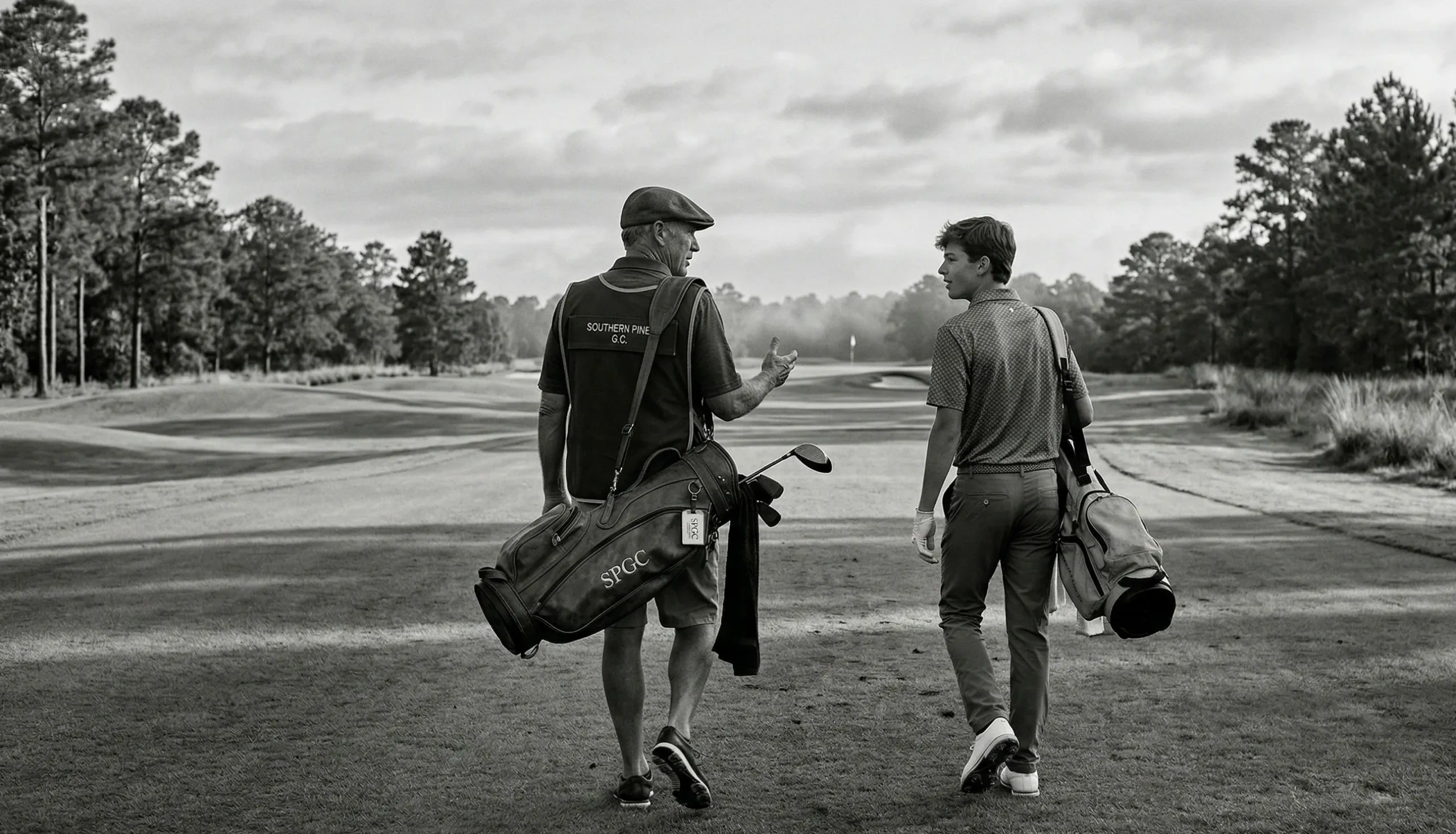
The Caddie Read
This Field Note is your guide for the week ahead. You will face several moments this week where a young player shows you their mental state through their actions. This might be someone you lead at work. You will see rushed choices. You will see bad contact with the ball. You will see anger that is way too big for the situation.
The question is not how do I fix this right now.
The question is what is this showing me about the heavy stress they are carrying.
The golf course is not where they picked up this heavy weight. The course is just the place where the weight becomes easy to see. Seeing the problem clearly is the first step. Meeting the problem with calm eyes instead of instant corrections is where the real honest work begins.
The Caddie Question for This Week
Think about a silent expectation. This could be your own rule or a rule from someone else. Which unsaid rule is creating the most pressure to perform in your room right now? We do not mean the rules people talk about out loud. We mean the heavy rule that everyone feels but nobody has named yet. Find it and name it aloud. That action is your very first swing.
Take the Next Step
If this lesson made sense to you and you want a good place to start, book a Foundational Groundwork session for $125. It is a one on one talk to find the real issues. It is available online or locally in the Southern Pines and Pinehurst area. It is designed to find the specific patterns in your life that are most ready to change.
Maybe you are leading at a very high level and want access to deeper and lasting work. The Inner Room is built just for the executive who is ready to use the course as a real tool for truth.
Field Notes are written to steady the mind, not to create hype. Golf is the lens we look through. Life is the real work.
Golf Ball Wisdom, Southern Pines, NC